 Login
 Please specify the quantity of product(s).

Fuld Object-Memory Evaluation
The Fuld Object-Memory Evaluation allows the examiner to evaluate memory and learning under conditions that support attention and reduce anxiety.
| Item | Product | Price | QTY |
|---|---|---|---|
| 33925 | Fuld Object-Memory Evaluation, Form I | $175.00 | |
| 33926 | Fuld Object-Memory Evaluation, Form 2 | $175.00 | |
| 33925R | Fuld Test Record Forms, Form I, Pk/30 | $49.00 | |
| 33926R | Fuld Record Forms, Form II, Pk/30 | $49.00 | |
| 33925M | Manual-Fuld Test | $49.00 | |
| 33926T | Fuld Test Manipulatives, Form II | $86.00 | |
| 33925T | Fuld Test Manipulatives, Form I | $86.00 |
 Add to Cart
The Fuld Object-Memory Evaluation
Measures memory and learning in older adults under conditions that support attention and reduce anxiety.
By Paula Altman Fuld, Ph.D.
| Age Range: | Older adults, 70-90 years |
| Time: | Approximately 15 minutes |
| Qualification Level: | C |
| Format: | Paper-and-pencil; individual administration |
| Benefit: | Assess memory and learning |
The Fuld Object-Memory Evaluation allows the examiner to evaluate memory and learning under conditions that support attention and minimize anxiety. It eliminates questions about the effects of poor vision, hearing, language handicaps, cultural differences, or inattention because the procedure supports examinee attention even under adverse testing conditions.
The test was developed with hundreds of aged adults, nursing home residents and community active people, for whom norms are provided. It has also proved easy to administer and effective with school-age children (though normative data are not available for children). The blind or deaf are not at a disadvantage on this test. It provides separate scores for long term storage, retrieval, consistency of retrieval, and failure to recall items even after receiving reminder prompts (e.g., after a recall trial the examiner states the items the examinee did not name). It provides a chance to observe word-finding ability, left-right orientation, stereognosis, and verbal fluency.
Ten common objects in a bag are presented to determine whether the patient can identify objects by touch (stereognosis). The patient is not told that memory of this event will be tested. (Left and right hands are alternated systematically, providing information about the patient's left-right orientation). The patient names, or describes, each object and then pulls it out of the bag "to see if it was right." After distracting the patient, by asking the patient to say words rapidly from a single category (rapid verbal retrieval), the patient is asked to recall the things from the bag. The patient is then offered four more chances to learn and recall them (store and retrieve) by reminding the patient of omitted items after each recall, with rapid verbal retrieval preventing rehearsal before each recall opportunity. Two equivalent alternate forms of the test are available.
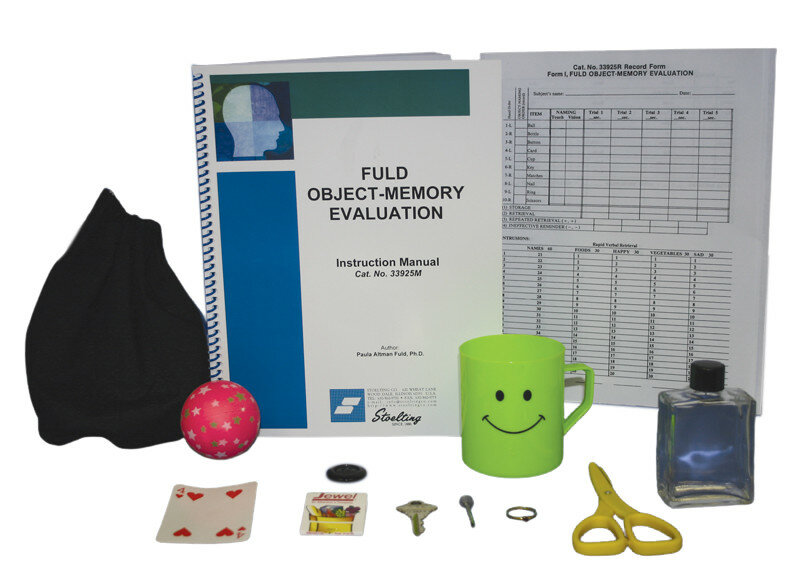
Objects found in the Form I Kit (33925) are: Ball, Bottle, Button, Card, Cup, Key, Matches, Nail, Ring, and Scissors
Objects found in the Form II Kit (33926) are: Can, Comb, Lock, Nail file, Pencil, Rubber Band, Spoon, Coin, Toothbrush, Wristwatch
Purchasing Options:
The Fuld Object-Memory Evaluation Form 1 Kit (33925) includes everything needed to administer the test: All manipulatives (Ball, Bottle, Button, Card, Cup, Key, Matches, Nail, Ring, and Scissors; black cloth bag to store manipulatives and to use during administration - 33925T), a package of 30 Form I Record Forms (33925R), and the test manual (33925M)
The Fuld Object-Memory Evaluation Form 2 Kit (33926) is an alternative form kit with alternative manipulatives and also includes everything needed to administer the test: All manipulatives (Can, Comb, Lock, Nail file, Pencil, Rubber Band, Spoon, Coin, Toothbrush, Wristwatch; black cloth bag to store manipulatives and to use during administration - 33926T), a package of 30 Form II Record Forms (33926R), and the test manual (33925M)
Record Forms, manipulatives, and the test manual are also available for purchase separately.
References
Loewenstein, D. (1995). The Fuld OME as a more culture-fair memory test in the elderly. Clinical Gerontologist, 15(4), 52–54.
- Discusses the Fuld Object-Memory Evaluation as a potentially more culturally fair approach to assessing memory in older adults.
Ortiz, I. E., LaRue, A., Romero, L. J., Sassaman, M. F., & Lindeman, R. D. (1997). Comparison of cultural bias in two cognitive screening instruments in elderly Hispanic patients in New Mexico. The American Journal of Geriatric Psychiatry, 5(4), 333–338. https://doi.org/10.1097/00019442-199700540-00008
- In a sample of older Hispanic adults in New Mexico, lower education and income were associated with performance on the Mini-Mental State Examination (MMSE). The study found no such association for the Fuld Object-Memory Evaluation.
Summers, J. D., Lichtenberg, P. A., & Vangel, S. J. (1995). Fuld Object-Memory Evaluation in an urban geriatric population. Clinical Gerontologist, 15(4), 21–34. https://doi.org/10.1300/J018v15n04_03
- The authors examined the Fuld Object-Memory Evaluation in a sample of urban older adults.
Wall, J. R., Deshpande, S. A., MacNeill, S. E., & Lichtenberg, P. A. (1998). The Fuld Object Memory Evaluation, a useful tool in the assessment of urban geriatric patients. Clinical Gerontologist, 19(1), 39–49. https://doi.org/10.1300/J018v19n01_04
- The researchers administered the Fuld Object Memory Evaluation to 146 older adults admitted to an urban geriatric rehabilitation program. Fuld scores correlated significantly with other standardized measures of memory.